Illinois voters just finished one election and the next one is already 14 weeks away. If that feels like a lot, it is: Illinois holds four different kinds of elections on a repeating two-year loop, and each one fills a different set of offices.
This guide explains the loop in plain English. It covers what was decided on November 3, 2026, which elections come next, what each one is for, and who actually runs the election where you live. No opinions and no endorsements. Just how it works.
The Short Version
- Even-numbered years are for federal, state and county offices: a primary in March, then the general election in November.
- Odd-numbered years are for local offices: mayors, city councils, village boards, school boards, park and library boards. Those are decided in the April consolidated election, with a February primary only where one is needed.
- Chicago does it a little differently: the city votes for mayor, clerk, treasurer and all 50 City Council seats in February, with runoffs in April.
- Next up: February 23, 2027 and April 6, 2027.
Four Kinds of Elections, One Two-Year Loop
Tap any stop on the loop to see what that election is for and who is on the ballot.
Consolidated Primary
Tuesday, February 23, 2027
What it is
A local primary held in odd-numbered years, and only where one is needed to narrow the field. In Chicago, this is the main municipal election.
On the ballot
Chicago: mayor, city clerk, city treasurer and all 50 City Council seats. Elsewhere: some city and village offices.
Good to know
Many towns have no February election at all. In Chicago, a candidate needs more than half the vote to win outright. If no one gets there, the top two meet in an April runoff.
Dates come from the Illinois State Board of Elections calendar. Offices vary by community, so check your own ballot with your local election authority.
What Happened on November 3, 2026
November 3 was the general election, the fall stop on the even-year side of the loop. Here is what was decided, with no commentary. Percentages are rounded from unofficial counts reported by news organizations in the days after the election. Results become official once local election authorities finish counting and the Illinois State Board of Elections certifies them.
Statewide offices
| Office | Winner | About | Also on the ballot |
|---|---|---|---|
| U.S. Senate (open seat) | Juliana Stratton (D) | 62% | Don Tracy (R), 36% |
| Governor and lieutenant governor | JB Pritzker and Christian Mitchell (D) | 61% | Darren Bailey (R), 36%; Collin Corbett, 3% |
| Attorney general | Kwame Raoul (D) | 62% | Bob Fioretti (R), 38% |
| Secretary of state | Alexi Giannoulias (D) | 65% | Diane Harris (R), 35% |
| Comptroller (open seat) | Margaret Croke (D) | 61% | Bryan Drew (R), 39% |
| Treasurer | Michael Frerichs (D) | 63% | Max Solomon (R), 37% |
Congress and the legislature
- U.S. House: Illinois has 17 seats. Democrats won 14 and Republicans won 3.
- New members: Five districts had no incumbent running. They elected Donna Miller (2nd), Patty Garcia (4th), La Shawn Ford (7th), Melissa Bean (8th) and Daniel Biss (9th).
- Illinois General Assembly: All 118 House seats and 39 of the 59 Senate seats were on the ballot. Democrats kept their majorities in both chambers. A handful of close races were still being counted after election night.
Cook County and Chicago
- Cook County Board president: Toni Preckwinkle (D) was re-elected with about 79%.
- Cook County assessor: Pat Hynes (D) won with about 86%.
- Other countywide offices: Treasurer Maria Pappas and Sheriff Tom Dart were re-elected.
- Chicago Board of Education: For the first time, voters elected all 21 members: one from each of 20 districts plus a citywide president. Jessica Biggs won the president’s race with about 49% in a three-way contest.
- Turnout: Early Chicago figures put turnout at about 42% of registered voters, with late mail ballots still to be added. More than 1.8 million Illinoisans had voted early or by mail before Election Day.
Who Runs Your Election? Tap Your County
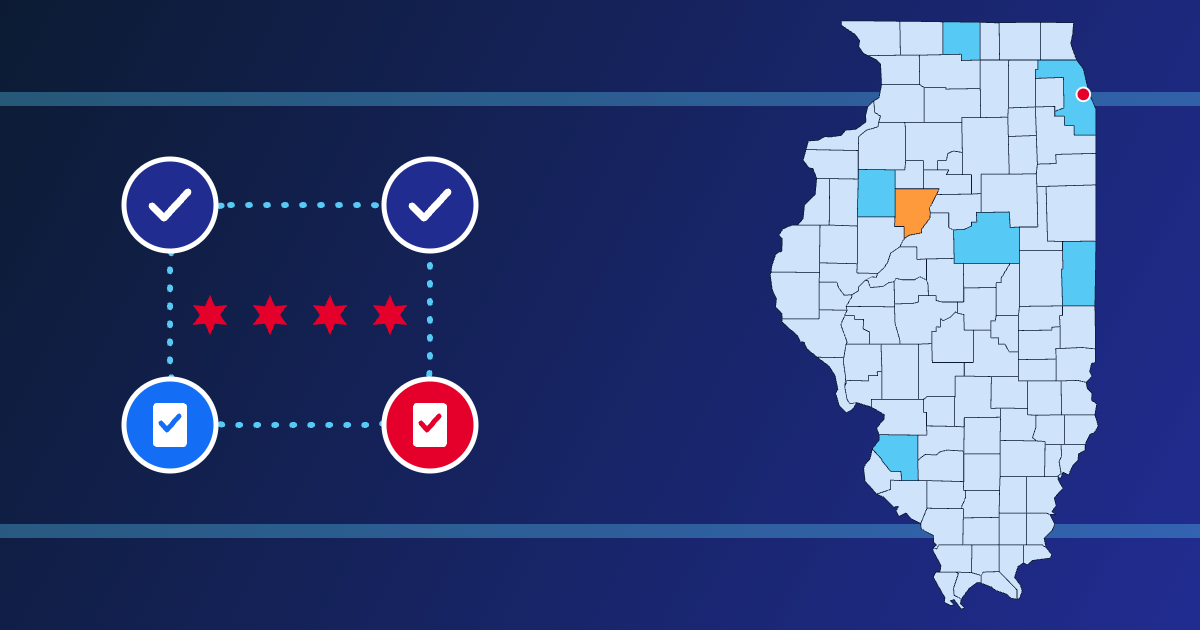
Illinois does not have one statewide election office that counts every ballot. Elections are run locally by 108 election authorities. In most places that is your county clerk. Six cities and one county have their own election commission instead. Tap the map or pick a county from the list.
Cook County
- Who runs elections here
- Next elections
- Look it up
- Find your election authority at elections.il.gov
- County clerk
- County clerk plus a city election board
- County election commission
- City with its own election board
What’s Next: The 2027 Local Elections
With the November election finished, Illinois moves to the odd-year side of the loop. These are the elections closest to home: the people who set your property tax levy, run your schools, plow your streets and decide what gets built down the block.
February 23, 2027: Consolidated Primary
In most of Illinois this is a “primary if necessary.” A town only votes in February if enough candidates file that the field has to be narrowed, or if local parties hold primaries. Many communities skip it entirely.
Chicago is the big exception. February 23 is the city’s municipal election for mayor, city clerk, city treasurer and all 50 City Council seats. The races are nonpartisan, so there are no party labels on the ballot. Any candidate who wins more than half the vote is elected. In any race where nobody does, the top two finishers go to a runoff.
April 6, 2027: Consolidated Election
This is local election day for the rest of the state, and runoff day in Chicago. Depending on where you live, your ballot can include:
- Mayor or village president, city council or village board, clerk and treasurer
- School board members
- Park district, library district and fire protection district boards
- Community college trustees
- Local referendums, such as bond issues or tax questions
Illinois has more units of local government than any other state, which is why two neighbors a few blocks apart can have different ballots.
Then the loop starts over
The next general primary is March 21, 2028, followed by the general election on November 7, 2028. That is a presidential year, so the top of the ballot changes, but the pattern is the same: parties pick nominees in March, everyone votes in November.
Who Is Elected When
| Level | Examples | Elected in |
|---|---|---|
| Federal | President, U.S. senators, U.S. representatives | November of even years |
| State | Governor, attorney general, secretary of state, comptroller, treasurer, state senators and representatives | November of even years (statewide officers every four years: 2026, 2030) |
| County | County board, clerk, treasurer, sheriff, assessor, state’s attorney, judges | November of even years |
| City of Chicago | Mayor, clerk, treasurer, City Council | February of odd years, runoffs in April (every four years: 2027, 2031) |
| Chicago Board of Education | President and 20 district members | November of even years |
| Other cities, villages and local districts | Mayors, village boards, school, park, library and fire boards | April of odd years |
Common Questions
What is a consolidated election in Illinois?
When is the next election in Illinois?
Why does Chicago vote in February?
Do I have to register with a party to vote in an Illinois primary?
Who runs elections in Illinois?
When are the November 3, 2026 results official?
How do I check my registration or find my polling place?
Running in 2027? Four Things Xblu Can Build Fast
Local races are won by small margins and short timelines. Voters look up names they have never heard of, usually on a phone, usually a few days before they vote. Xblu builds campaign technology for Chicago and Illinois campaigns of any party and any size, from a school board seat to a citywide office. Here is what we can stand up quickly once your content is ready.
A starter campaign website
Who you are, what you stand for, events, and clear ways to volunteer or donate. Built for phones first and set up so search engines can find your name. A fuller site takes about a week.Quick survey and polling pages
A short, phone-friendly survey that asks your ward or district what matters most. Opt-in only, results shown in totals, and no push polls. Share it with a link or a QR code on a door hanger.Interactive maps and data
Maps like the one above for your own race: wards, precincts or districts that visitors can tap, plus animated charts built from public results, Census data and your survey totals.Supporter sign-ups that stay organized
Volunteer forms, yard sign requests and meeting booking that feed one simple list, so nobody falls through the cracks. Opt-in email updates written by your team go out from the same place.Sources and official links
- Illinois State Board of Elections: election calendar, election authorities, voter lookup
- Chicago Board of Election Commissioners
- Cook County Clerk, Elections
- November 3 figures: unofficial results as reported by NBC Chicago, CBS News Chicago, ABC7 Chicago, WTTW and Chalkbeat Chicago, November 3 to 5, 2026
This guide is general information, not legal advice, and it takes no position on any candidate, party or ballot question. Election dates and rules can change. Confirm deadlines with your local election authority. Published November 17, 2026.